Specifications
| Property |
Detail |
| Brand |
TianBonsai |
| Series |
Professional grade |
| Cutting edge material |
5Cr15MoV alloy steel |
| Edge construction |
Stage-forged, then finely polished |
| Edge hardness |
HRC60 |
| Quenching |
High-frequency coil |
| Overall length |
180 mm |
| Weight |
About 80 g |
| Handle |
Ergonomic, anti-slip grip |
Where These Scissors Earn Their Keep
Spring and summer are when this pair works hardest. On maples and elms it stops a growing tip cleanly so the pair of buds just below keeps its line; on pines it cuts candles and shortens needles close to the branch collar, where a broad blade is clumsy to place. Through the growing season the same blade thins the small twigs that build fine ramification, and on shohin and mame it reaches into tight interiors for leaf and petiole work that longer bonsai pruning scissors cannot get to. On a teaching bench, the short frame lets a student watch the blade tip and the cut line at the same time.
Matching the Tool to the Job
- Buds, new shoots and the tips of young twigs — this pair is the one to take to a finished tree.
- Thicker branches — step up to a straight-edge branch cutter; its 4Cr13MoV edge leaves the clean, bark-friendly cut that bonsai tree scissors cannot make on hardwood.
- Higher or heavier green shoots — the professional range includes a 210 mm long-handle scissors with more leverage for work further out on the tree.
- A complete kit — multi-piece sets bundle cutting tools with the cases and roll bags that carry them, and they sit alongside everything else in our bonsai tools for sale range.
Using and Looking After the Pair
- Close the blades with a slight vertical force on the two handles, applied in opposite directions — a light, deliberate close is all the cut needs.
- Check the closed position before you start: with the handles closed the blade tips touch, and with the handles open a little play at the rivet is normal rather than a fault.
- Brush grit, sand and flower-mud debris off the branch before cutting; fine particles roll along a hard edge and blunt it faster than clean wood does.
- Protect the tip — even a light frontal knock can damage the point, so set the pair into its tray or sleeve instead of down on a hard bench.
- Keep hands, wrists and anyone nearby clear of the line of the cut, and never leave the scissors on a high shelf or bench edge where a knock could send them down.
- Wipe the blades dry after every session and store them dry; the polished edge resists rust as long as it is not left wet, and moisture on steel is what shortens the working life of any bonsai tools, this pair included.
About TianBonsai
| Property |
Detail |
| Experience |
Making bonsai tools since 2013 |
| Customers served |
More than 100,000 |
| Customer rating |
5.0 out of 5, from 183 reviews |
| Units sold |
1,086 |
| Production background |
Crafted tools for established bonsai tool brands |
| Own brands |
TianBonsai, Mu-Tian and Standard Series |
Scale & Supply Capability
TianBonsai is a bonsai-tool brand with a focused, deep range: carving knives and gravers, bud scissors, branch cutters, wire cutters, multi-piece tool sets, and the cases and roll bags that carry them. Across the series we work in specified alloy steels — 4Cr13MoV, 5Cr15MoV and Mn18Cr2 — with high-frequency quenching, forged edges, right- and left-handed options, and patent-design storage. Ordering from us means one consistent standard of forging, hardening and finishing, and a range that grows with your practice.
FAQ
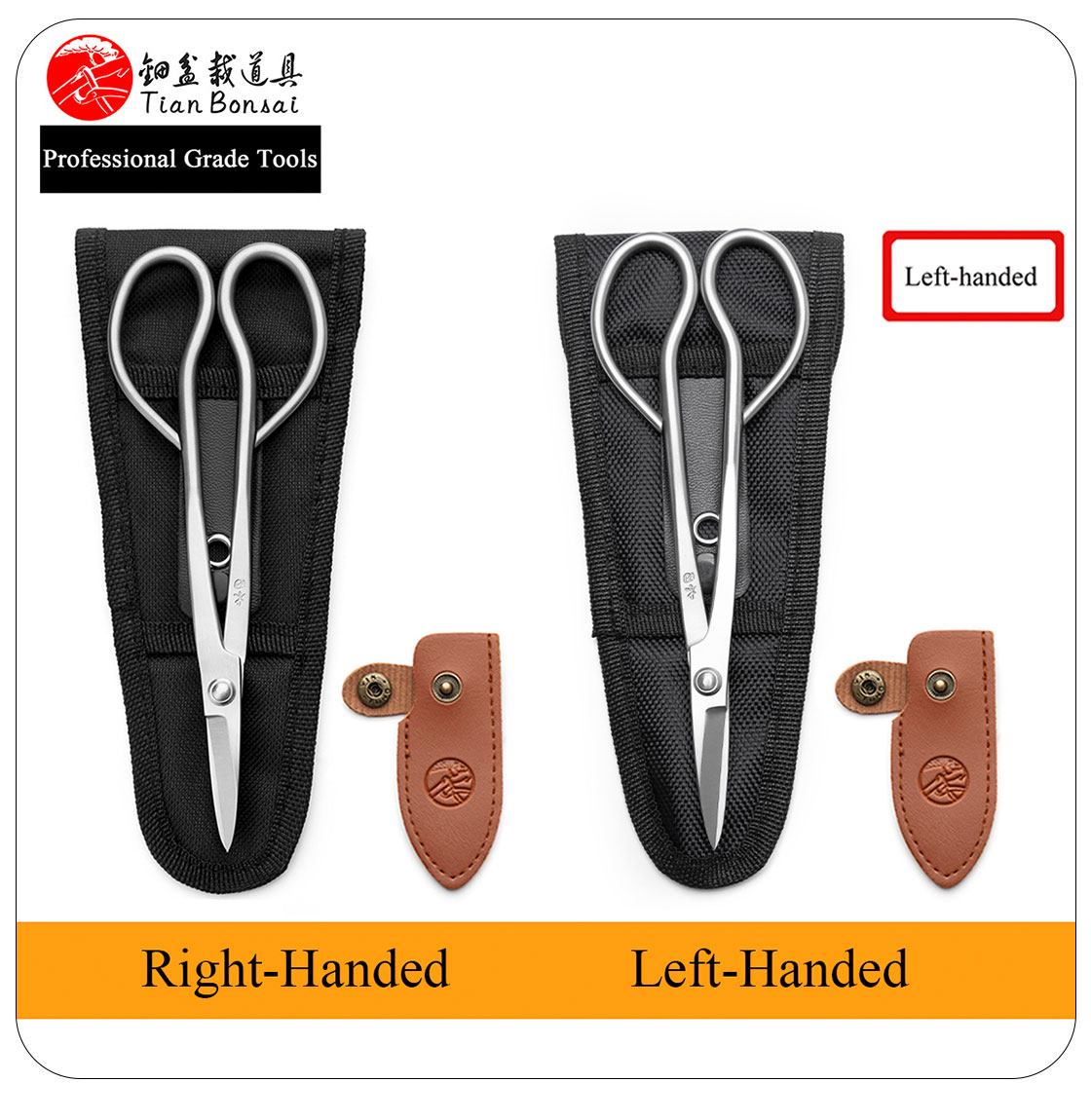
Q1. Should I order the right-handed or the left-handed version?
The two versions share the same pattern; what differs is the side the cutting bevel sits on, so the blade face stays outside the cut where your leading hand can see it. If you steer scissors with your right hand, choose the right-handed pair; if your left hand leads, choose the left-handed version. Both are standard options rather than special orders.
Q2. I am new to bonsai — is this a good first pair?
It is, because a short frame is easier to control than long bonsai pruning scissors, and the fine blade shows you exactly where the cut will land, which is the hardest judgement to learn. Start with soft green growth, and let the blade do the work rather than squeezing the handles. The pair will keep up as your technique improves.
Q3. How thick a shoot or branch will these cut?
The useful answer is to let the cut guide you rather than a number, because species and wood density change what an edge will take cleanly. Soft green growth is the everyday work here, and if a shoot resists, it is past what these bonsai scissors are made for. Forcing the blade strains the joint and rolls the edge, so stop and change tools rather than squeezing harder.
Q4. What does the sanded finish on the blades actually do?
The blade faces are sanded to a smooth, low-glare surface that wipes free of sap and does not hold dirt while you are working inside dense foliage. What it gives you is a blade that runs cleanly through the work rather than extra sharpness — the cutting quality comes from the edge beneath the finish. It is a small detail that becomes noticeable over a long session of detail work.
Q5. Why is there a gap between the blades when the scissors are closed?
That gap is designed in, not a defect. Ordinary scissors shear flat material and need their blades tight together, but these bonsai shears work as a wedge on a lever, so a round stem parts cleanly instead of being crushed, the cut heals faster, and the blade is spared metal-on-metal wear. It is a pair made for live plants rather than paper.
Q6. Can I use these on dry deadwood or to cut bonsai wire?
Dry, hardened branches chip a fine edge, so keep this pair on live tissue. Aluminum wire comes off with our forged wire cutter, whose extended working part frees the wire without injuring the branch, and Jin and Shin deadwood is shaped with the gravers and carving knives rather than with bonsai tree scissors. Using each tool on the job it was made for is what keeps an edge sharp.


