Blade Profiles
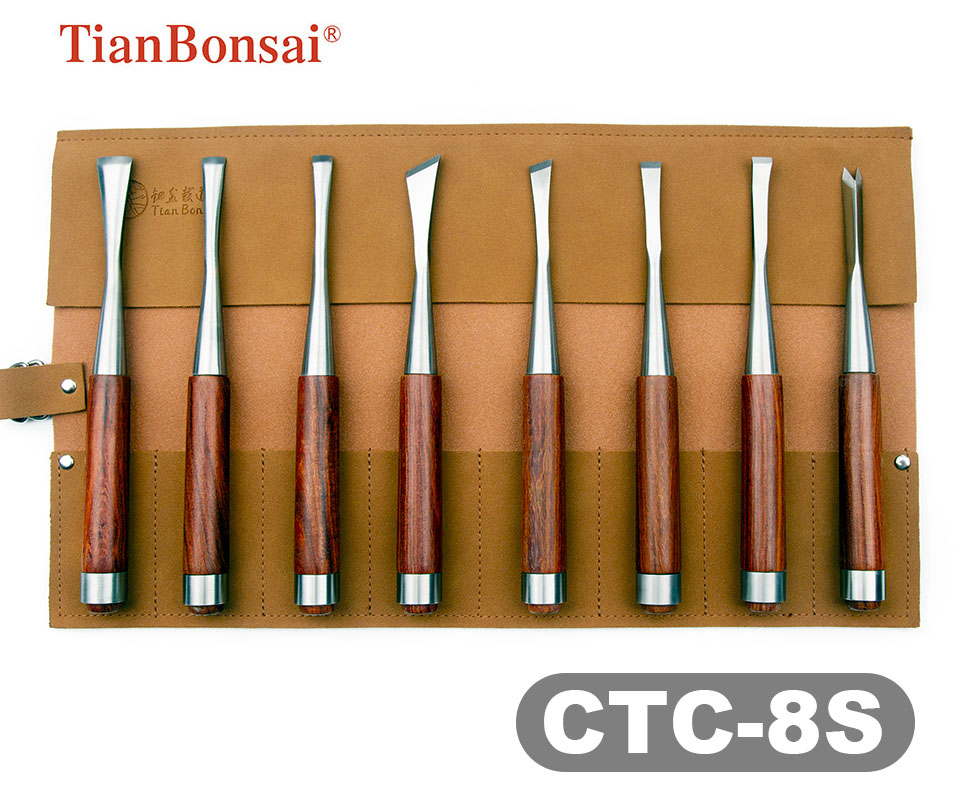
- Curved blades — for hollowing a rot pocket or a limb stub, following the natural sweep of the cavity instead of cutting straight through it.
- Straight blades — for flattening the floor of a hollow and planing long faces of deadwood so the grain reads cleanly from a distance.
- Narrow blades — for fine work close to the live wood, where a wide edge would risk catching bark you want to keep.
- Wider blades — for blocking out a large weathered face quickly, before the finer knives come in to define it.
- A graded range — the eight bonsai knife profiles step from narrow to wide, so you can rough out with one blade and move straight to finishing with the next.
Specifications
| Set |
Eight-piece bonsai carving knife set |
| Model |
CTC-8S |
| Blade material |
5Cr15MoV alloy steel |
| Handle material |
Red rosewood |
| End ring |
Stainless steel |
| Blade profiles |
Curved to straight, narrow to wide |
| Main work |
Deadwood carving and fine texture work |
| Also used for |
Smooth bark texture, slender branch shaping, trimming dead branches |
| Storage |
Compact leather roll, supplied with the set |
| Single knives |
CTCA-01 to CTCA-08 available separately |
| Suits |
Beginners through to experienced carvers |
Steel & Handle Build
The blades are 5Cr15MoV alloy steel, finished with a keen, durable cutting edge. It is an alloy chosen for carving rather than heavy pruning: it takes a fine edge, holds it through long sessions of paring and scraping, and stays clean more easily than a carbon blade. Handles are cut from red rosewood — dense, warm in the hand and shaped for a light, controlled grip over long sessions of detailed work. Built as stainless steel bonsai tools rather than carbon-steel blades, the set copes with a damp afternoon in the garden far better than a plain carbon edge would.
Care & Storage
- Wipe the blades as soon as you finish, while sap and green wood residue are still soft.
- Shake grit and dust out of the roll before the knives go back in — grit left in a slot will scratch a blade.
- Roll the set so the blades sit apart and cannot knock against each other in transit.
- Store the roll somewhere dry, not in a damp shed and not loose in a toolbox with heavier steel.
- Keep the pressure on the wood, not on the blade: a carving knife is not a lever, a pry bar or a scraper for gritty surfaces.
Jin & Shin Work
- Creating a Jin on a juniper — hollow an old branch stub back to sound wood, then use the curved and narrow bonsai carving tools to follow the grain and taper the deadwood so it reads as weather-worn rather than cut.
- Opening a shari down a trunk — a straight blade planes the floor of the channel, a wider edge opens the face, and a narrow tip cleans the boundary beside the live bark.
- Refining an established feature — on a tree worked years ago the edges soften and the grain closes up; the set lets you re-cut those lines and bring back definition without touching the rest of the design.
- Detailing before a show — light passes with a narrow blade lift fuzz and tool marks off a finished tree so the deadwood reads as age rather than recent work.
- Collected and field-grown material — the wider knives clear soft, punky wood first, and the finer blades finish the hollow once you find solid timber.
Scale & Supply Capability
TianBonsai is a bonsai-tool brand with a focused, deep range: carving knives and gravers, bud scissors, branch cutters, wire cutters, multi-piece tool sets, and the cases and roll bags that carry them. Across the series we work in specified alloy steels — 4Cr13MoV, 5Cr15MoV and Mn18Cr2 — with high-frequency quenching, forged edges, right- and left-handed options, and patent-design storage. Ordering from us means one consistent standard of forging, hardening and finishing, and a range that grows with your practice.
FAQ
Q1. Is this set suitable for a beginner?
Yes. These bonsai carving tools are made for newcomers as much as for experienced carvers — the eight profiles let you follow the shape of the wood instead of forcing a line with the wrong blade. Start with a straight blade to open up the grain, then move to a curved or narrow knife as your hand gets used to the cut.
Q2. How do I keep the cutting edges sharp?
A few light passes on a fine sharpening stone, held at the same angle as the original bevel, will bring the edge back. Every bonsai knife in the set is shaped to be touched up rather than re-ground, so work slowly and check the edge as you go. A strop or fine stone is kinder to a carving edge than a coarse file.
Q3. Can I use them for bark, branches and general trimming, not just deadwood?
Yes. The set also handles smooth bark texture, slender branch shaping and trimming away dead branches, so it covers far more than Jin work alone. Use a wide blade to remove material and a narrow one to finish close to the wood you want to keep. For heavier structural cuts you would still reach for branch cutters and scissors, the rest of a bonsai tool kit.
Q4. Can I buy a single knife instead of all eight?
Yes. The individual knives are sold on their own, so you can replace a worn blade or add the profile you use most without buying the full set. Tell us the shape you work with and we will match it. If you are browsing bonsai tools for sale for the first time, the eight-piece set is the simpler place to start.
Q5. Will the blades rust if I carve outdoors in damp weather?
The blades are made from a stainless alloy steel, so a damp afternoon in the garden will not damage them the way a plain carbon blade suffers. Even so, wipe them dry and give the steel a thin film of tool or camellia oil before the set goes back in the roll, especially if it will be stored for a while. Stainless steel bonsai tools last longer when they are put away dry.
Q6. What is the stainless steel end ring on each handle for?
It caps the base of the rosewood handle and takes the load when you press hard into a cut. That is what stops the wood from cracking or splitting under heavy use, and it protects the end grain from the knocks a working knife picks up over the years.


