About this cutter
Wiring a tree has two halves: putting the wire on, and taking it off once a branch holds its new line. These bonsai wire cutters are built for the second half. Hobbyists working a single tree, studio artists moving down a bench, and nursery staff running a rewiring programme all reach for the same tool, and it sits in the range beside our cutters, scissors and pliers. Nothing about it is tied to one species or style, so it earns its place whether you keep three trees or three hundred.
Steel, hardening and finish
| Property |
Detail |
| Material |
4Cr13MoV alloy steel |
| Steel family |
Chromium stainless, 13% Cr |
| Carbon content |
0.4% |
| Alloying elements |
Molybdenum and vanadium |
| Quenching |
High-frequency coil |
| Edge hardness |
Over HRC55 |
| Edge character |
High strength, strong tenacity, wear resistant |
| Handle |
Stamped with the TianBonsai professional grade mark |
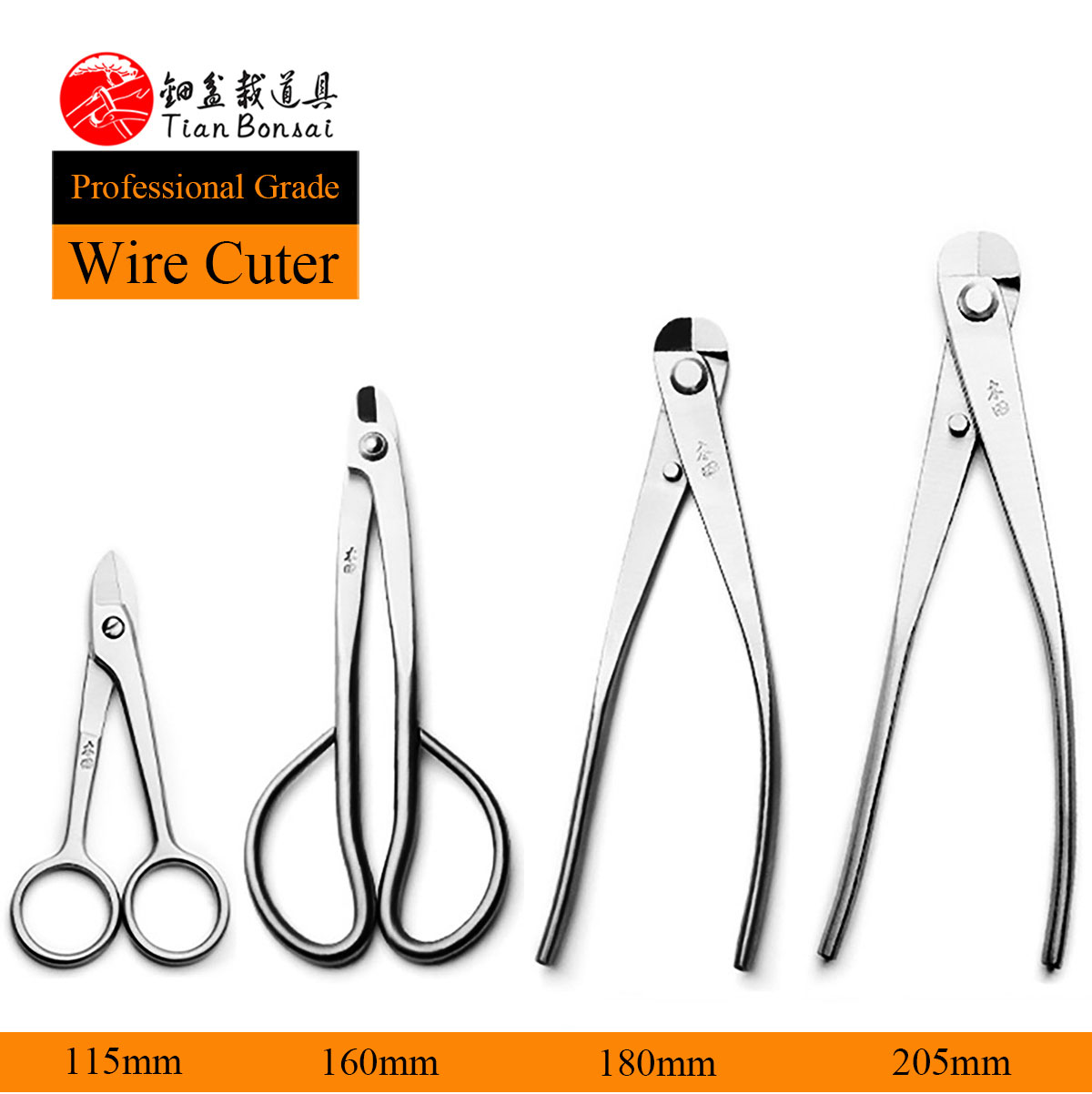
Choosing a head length
- 115 mm: the shortest head, for thin wire and fine work on shohin and other small trees where a longer tool will not fit between the shoots.
- 160 mm: a compact middle size that suits small to medium trees, and hands that find the shortest handle cramped.
- 180 mm: the everyday length for medium material and a full session at the bench, with enough reach without feeling long in the hand.
- 205 mm: the longest option, giving extra leverage on heavier aluminum wire and more distance from the trunk on larger trees.
Where this cutter stops
- Cut training wire only. Dry branches, roots and deadwood need a branch cutter or a root cutter, and this thin, hard edge will not stand up to wood.
- Stay inside what the head is built for. If a coil will not sit comfortably between the jaws, step up to a longer head instead of forcing the handles.
- Check the branch before you cut, because fine grit and dried soil trapped in the bark dull an edge faster than wire does.
- Keep the tool off bench edges and out of high places; even a light drop can chip the tip.
- Treat it as the sharp tool it is, and keep your fingers and anyone nearby clear of the jaws while cutting.
Scale & Supply Capability
TianBonsai is a bonsai-tool brand with a focused, deep range: carving knives and gravers, bud scissors, branch cutters, wire cutters, multi-piece tool sets, and the cases and roll bags that carry them. Across the series we work in specified alloy steels — 4Cr13MoV, 5Cr15MoV and Mn18Cr2 — with high-frequency quenching, forged edges, right- and left-handed options, and patent-design storage. Ordering from us means one consistent standard of forging, hardening and finishing, and a range that grows with your practice.
FAQ
Q1. Which length should I start with?
For a first cutter, 180 mm covers most medium trees and stays comfortable through a long session at the bench. If your collection leans small, the 115 mm head is the one to add instead, where a longer tool gets in the way between fine shoots. Shops that stock bonsai tools for sale generally carry two or three lengths, which gives you the chance to compare them in the hand.
Q2. What wire can these bonsai wire cutters take?
Aluminum and copper training wire, in the gauges normally used to hold a bonsai branch in position. Both metals cut cleanly, and the jaws are shaped to close around wire that sits tight against the wood. Cut with the head that reaches the branch comfortably and the wire parts in one snip.
Q3. How do I take off wire that a branch has grown around?
Cut the coil into short sections and lift each piece away instead of unwinding it. Wire that has grown in holds tight, so unwinding drags it across the wood rather than letting it come free. Work slowly around the trunk, check the branch after each piece comes off, and if it looks stressed, spread the removal over more than one session.
Q4. How does 4Cr13MoV compare with your 5Cr15MoV tools?
4Cr13MoV sits one step below our 5Cr15MoV grade, and we say it plainly: it is still a professional steel, and it is the grade this head is made from. The 5Cr15MoV stainless steel bonsai tools hold their bite a little longer under heavy daily cutting, which matters most on scissors that work wood all day. For cutting wire, this steel is more than equal to the job.
Q5. How do I look after it between sessions?
Rinse the head in clean water after work so sap and soil do not dry inside the jaws, then dry it with a clean cloth. A single drop of general anti-rust oil on the riveted pivot, wiped back with a cloth, is enough to keep the joint moving freely. Store it indoors with your bonsai pruning tools rather than in a damp shed, and it will be ready for the next session.
Q6. Who makes this cutter, and is it held to the same standard as the rest of your range?
TianBonsai makes it in-house, with trained technicians forging and finishing every head rather than buying parts in. The same workshop also produces tools for other bonsai brands, so the methods carry across all our stainless steel bonsai tools. That consistency is why one length of this cutter feels like another in the hand.


